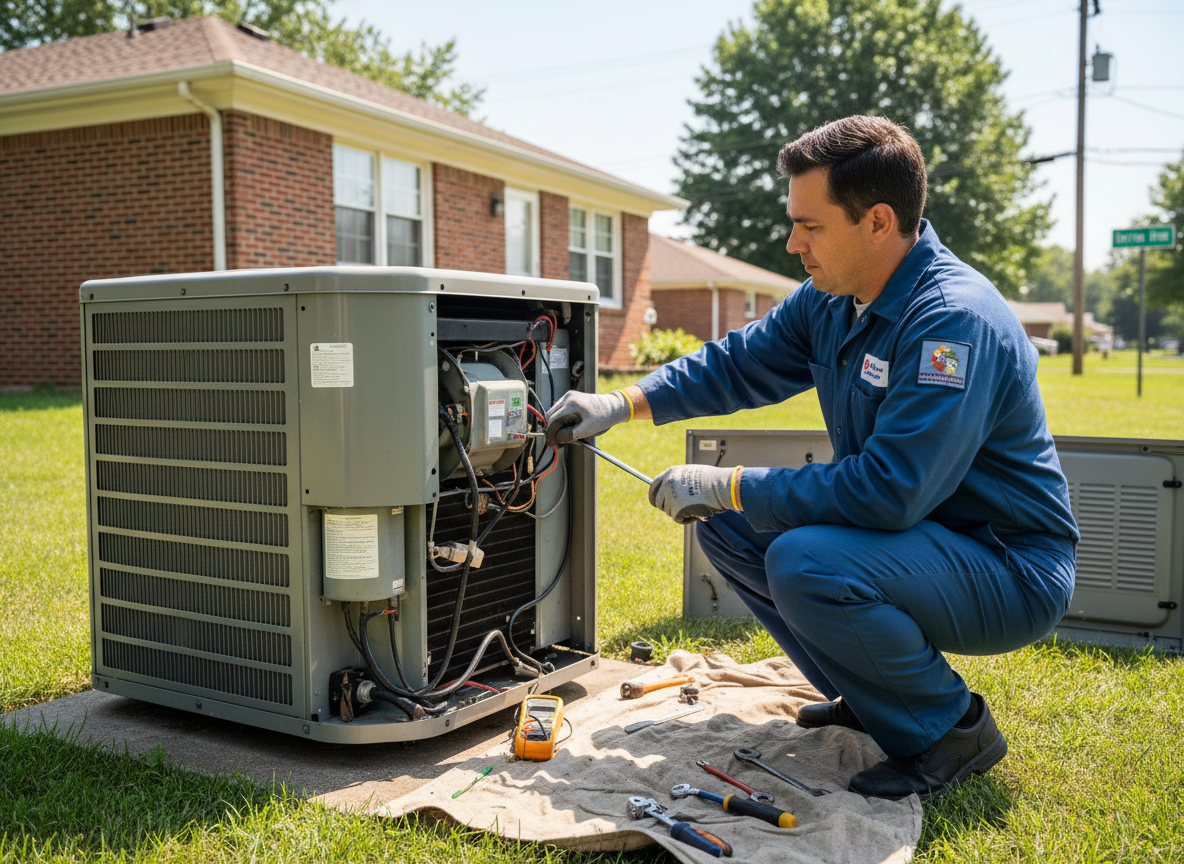
Dayton’s humid continental climate brings long stretches of high heat and humidity that push residential AC systems hard, especially in neighborhoods like the Oregon District and South Park where many homes date to the early 1900s. These properties often have original ductwork that was never sized for modern cooling loads or sealed against the moisture that infiltrates through uninsulated masonry and balloon framing. Technicians see coils icing over from restricted airflow and capacitors failing from the constant humidity load rather than simple age.
In Montgomery County, summer storms can drop power for hours and then surge back on, stressing compressors and control boards in systems installed before the 2000s. Homes near Carillon Historical Park and along University Row frequently sit on clay-heavy soil that holds water, raising indoor humidity even when the unit runs. Proper repair here means checking static pressure across the entire duct run and verifying condensate drains are clear before recharging, because a clogged line in these older layouts quickly leads to water damage on plaster ceilings.
Service calls in Kettering and Beavercreek often involve systems that were added during later renovations without updating the electrical service. Undersized disconnects and aluminum wiring become heat sources once the compressor starts pulling locked-rotor amps on the hottest days. A thorough repair includes verifying breaker size against the nameplate and confirming the outdoor unit sits on a level pad so the fan motor does not bind when the ground shifts after heavy rain.
Technician insight
In Dayton, the thing that catches most people out with AC Repair is the combination of high summer humidity and 1920s–1940s homes in the Oregon District and South Park. The original duct runs were never meant to handle latent loads, so a simple capacitor swap often masks low airflow that will kill the new compressor in one season if static pressure is not addressed.
South Park Bungalow No Cooling
Homeowner in a 1930s South Park bungalow reported the unit running nonstop without dropping temperature. We found low refrigerant from a vibration-cracked suction line and restricted return ducts lined with original plaster dust. After repairing the line, replacing the drier, and cleaning the returns we restored 18-degree split and proper humidity removal.
How it works
- 1
Initial Assessment
Arrive on site, confirm the complaint, and check thermostat settings plus basic power supply.
- 2
System Diagnostics
Measure pressures, temperatures, and electrical values at the indoor and outdoor units to isolate the fault.
- 3
Component Repair or Replacement
Replace failed parts such as capacitors, contactors, or TXVs using OEM or approved equivalents.
- 4
Performance Verification
Run the system through a full cycle, confirm proper airflow and temperature split, then document readings.
Pricing
Upfront quote provided after on-site inspection; no diagnostic fee applied to repairs.