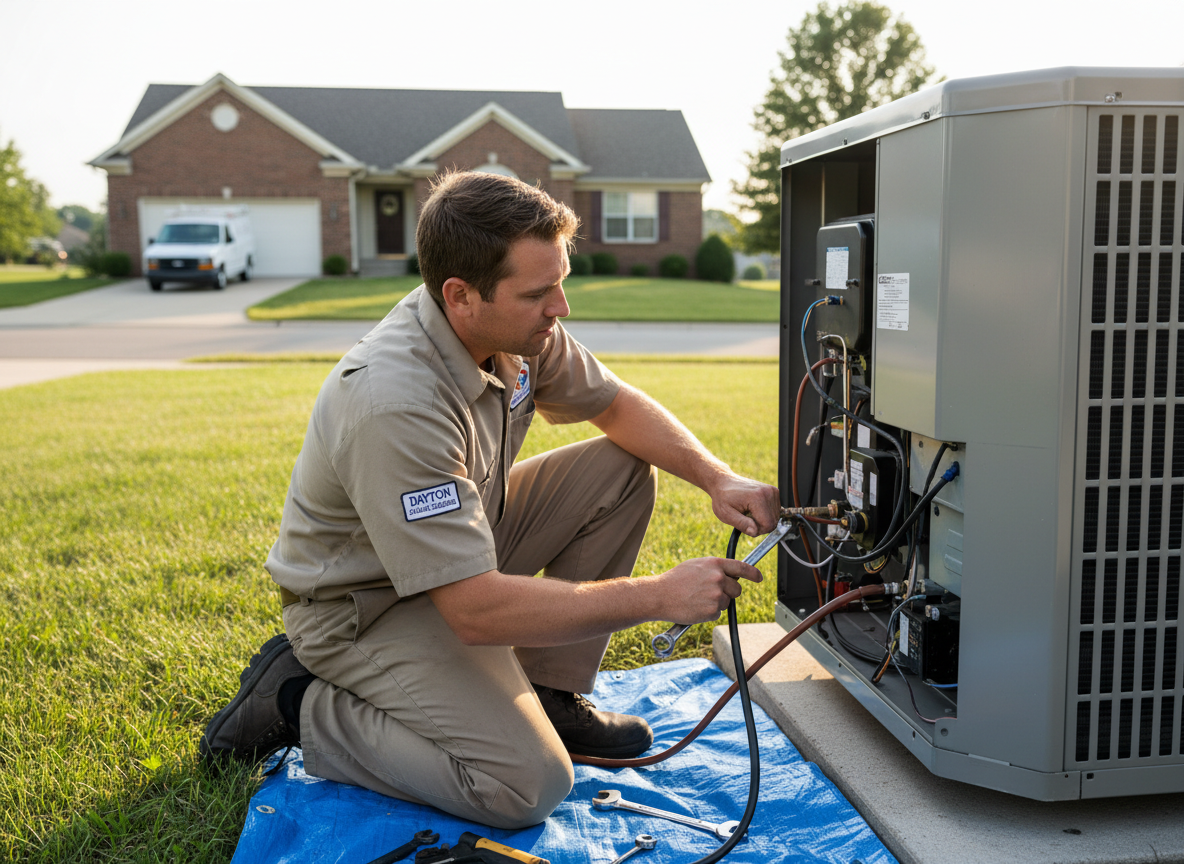
Dayton’s humid continental climate brings prolonged hot spells that push window units and central systems past their limits, especially in South Park and University Row where many homes date to the early 1900s with undersized ductwork and single-pane windows. Technicians at Perfect Temp, based at 2800 E 3rd St, routinely find compressors struggling against 90-plus-degree days combined with high humidity that forces constant runtime and coil icing. Older Montgomery County properties also show rusted condensate drains and outdated R-22 systems that require careful retrofits to meet current codes.
Calls from the Oregon District and nearby Kettering often involve capacitor failures or low refrigerant caused by vibration from decades-old ductwork settling on brick foundations. Technicians carry manifold gauges, leak detectors, and OEM contactors to address these issues without full system replacement when possible. Hot afternoons near the Dayton Art Institute or Carillon Historical Park can spike demand, so 24/7 dispatch from the East Third Street shop keeps response times short even on weekends.
Beavercreek subdivisions with newer builds still experience issues from pollen loading on condenser coils and improper attic insulation that lets heat soak into linesets. Perfect Temp techs check static pressure and clean drains on every visit because clogged lines in humid summers quickly lead to water damage on finished ceilings. These details separate quick fixes from repeat callbacks in the region’s varied housing stock.
Technician insight
In Dayton, the thing that catches most people out with AC Repair Near Me is how quickly older South Park and Oregon District homes develop low airflow from settled flex duct and dirty evaporator coils; the high summer humidity here turns a small restriction into a frozen coil overnight, and skipping the static-pressure check on the first visit just guarantees a callback once the next heat wave hits.
Frozen Coil in South Park Bungalow
Homeowner in a 1920s South Park house reported weak airflow and ice buildup on the indoor coil during a July heat wave. Inspection found collapsed flex duct in the crawlspace restricting return air and a clogged condensate line from pollen. Technicians replaced the damaged duct section, cleared the drain, and recharged the system to factory specs; the unit ran through the rest of the summer without further issues.
How it works
- 1
Initial Assessment
Technician arrives and reviews symptoms while checking thermostat settings, airflow at registers, and outdoor unit condition.
- 2
Diagnostic Testing
Pressure readings, electrical checks, and leak detection pinpoint the exact failure in compressors, capacitors, or coils.
- 3
Repair Execution
Parts are replaced or recharged on site using matched components suited to Dayton’s summer load demands.
- 4
System Verification
Post-repair run test confirms temperature split, drain function, and safe operation before departure.
Pricing
Upfront quotes after inspection with no hidden trip fees for 24/7 Dayton service.