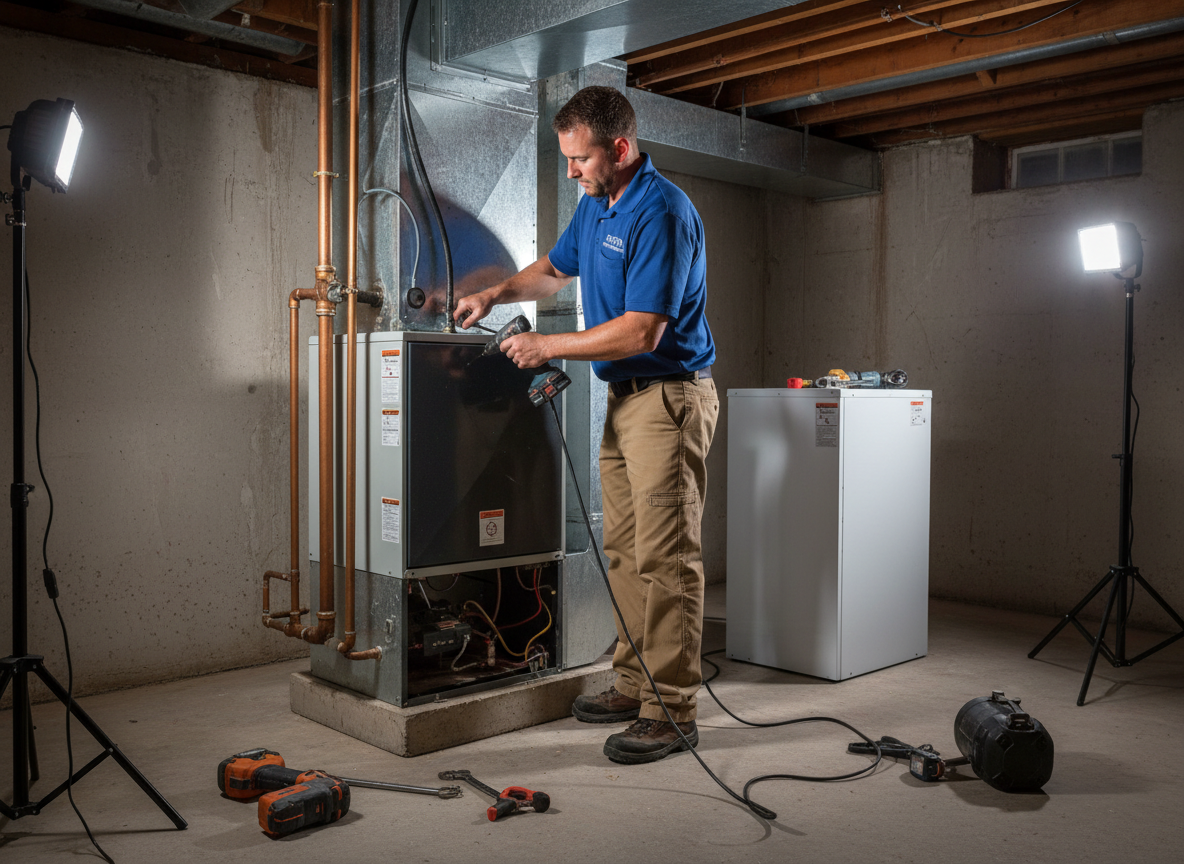
Dayton homes built before 1970 often carry original duct runs that have settled unevenly on clay-heavy Montgomery County soil. When replacing a furnace and air conditioner together, crews must check trunk line slope and seal every joint because winter temperature swings from single digits to the thirties force metal to expand and contract daily. Skipping this step leads to callback leaks once the first cold snap hits.
In neighborhoods such as University Row and Downtown Dayton, many two-story brick houses have limited mechanical closets. New high-efficiency units with variable-speed blowers require extra clearance for condensate drains that tie into existing sewer lines. Technicians frequently reroute lines through the basement rather than the attic to avoid freezing during overnight lows that dip below zero.
Kettering and Beavercreek properties sit on flatter terrain but still face summer humidity loads that push older systems past their design limits. A full replacement includes matching the new coil to the existing evaporator platform and verifying that the condensate pump can handle the increased volume without overflow during July thunderstorms.
Ductwork Assessment in Historic Homes
Before any equipment is ordered, a full static pressure test is performed on existing ducts in homes near the Dayton Art Institute and Carillon Historical Park. This reveals hidden restrictions that would otherwise cause the new system to short-cycle once installed.
Technician insight
In Dayton, the thing that catches most people out with HVAC Replacement is the narrow mechanical closets in Oregon District and South Park homes. The original builders never left room for modern high-efficiency cabinets, so we often have to rebuild the platform and reroute return air before the new unit will fit without choking airflow.
South Park Brick Two-Story
The existing 1980s unit struggled through last winter's cold snaps and could not keep up with summer humidity. Inspection showed collapsed flex duct in the crawl space and an undersized return. We removed the old system, rebuilt the return with rigid metal, and installed a new variable-speed unit matched to the existing trunk. The home now maintains even temperatures on both floors without the short cycling that had occurred before.
How it works
- 1
Site Evaluation
Measure existing equipment, inspect duct condition, and note electrical service capacity at the 2800 E 3rd St shop before scheduling.
- 2
Old System Removal
Disconnect and extract the furnace, coil, and condenser while protecting floors and landscaping common to South Park properties.
- 3
New Equipment Placement
Set the replacement unit on a level pad, reconnect modified duct transitions, and install a new condensate line sized for Dayton humidity.
- 4
Startup and Testing
Charge the system, verify airflow across all registers, and confirm thermostat communication before leaving the site.
Pricing
Pricing varies with home size, existing duct condition, and whether electrical upgrades are required; written quotes are provided after the site visit.